Same name, different balance
Two customers named Mara. One cleared ₱0. One owes ₱4,000. Without a single source of truth, you guess — and guess wrong in front of the client.

Solo app · 2026 · Live on App Store
Renty is the app I wished existed when I watched family rental operators chase balances in group chats, paper logbooks, and half-remembered GCash screenshots.
No cloud. No login. Offline on your phone — now on the App Store.
The problem
That's fine until it isn't — and it usually isn't on event weekend.
Two customers named Mara. One cleared ₱0. One owes ₱4,000. Without a single source of truth, you guess — and guess wrong in front of the client.
Debut on Saturday. Tent company promised the set. Your inventory says 8 units out — but you never logged the booking that ate the last two.
End of month. You're adding partial payments from memory. Pending collections is a number you hope is right because there's no running ledger.
Inside the build
Every module maps to a real question rental owners ask daily.
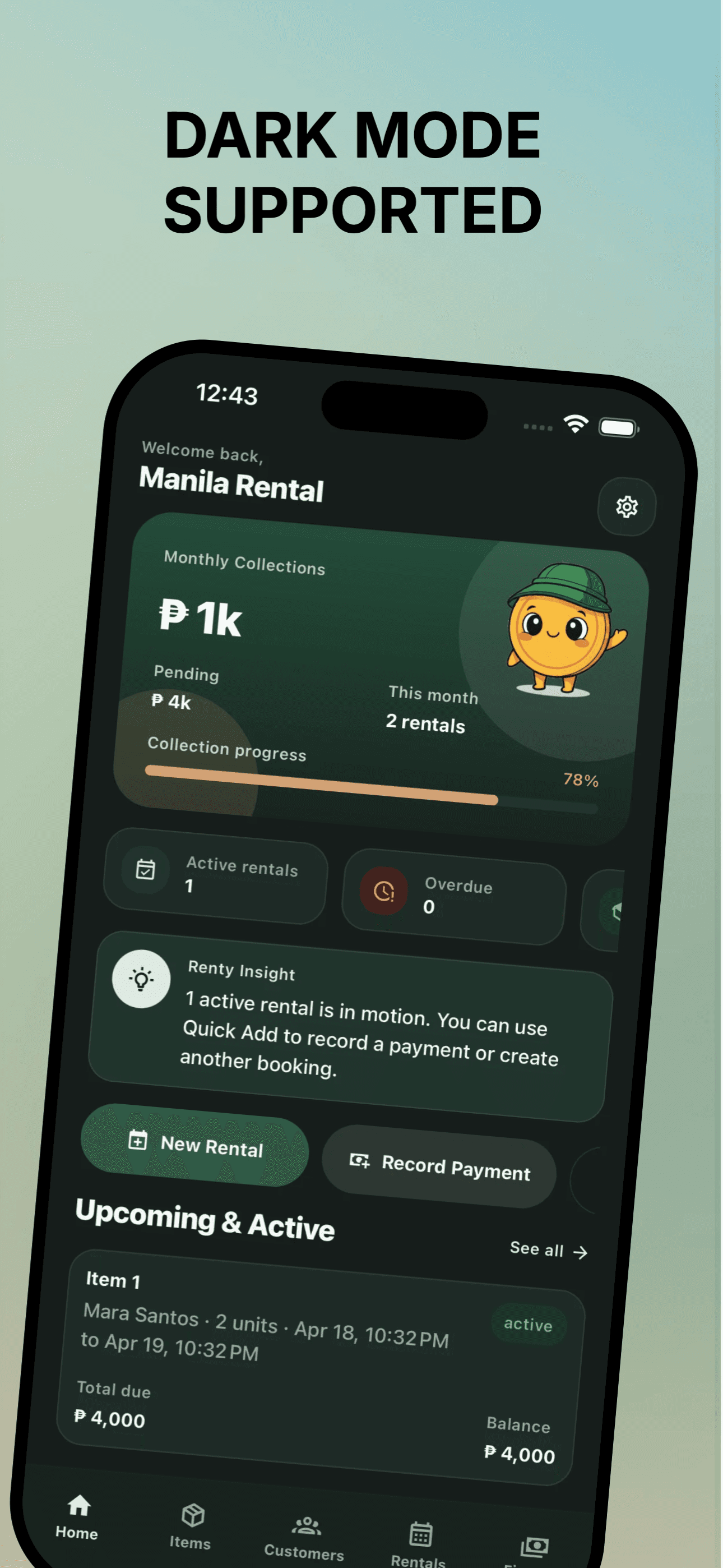
Monthly collections, pending balances, active rentals, overdue count — plus Renty insights that nudge you before small problems become Saturday disasters.
Screens
scroll the build →
Tap any frame to zoom.
Under the hood
It's the whole architecture. Renty opens straight to your dashboard — no account, no onboarding wall, no 'syncing…' spinner.
Bookings, payments, inventory, customers, packages, reminders — normalized with WAL mode and foreign keys. Built for real rental workflows, not a todo-app demo.
Property calls them tenants. Events call them customers. Vehicles call them renters. One app, vertical-aware copy — set once in business profile, reflected everywhere.
Your data never leaves the device unless you export it. Manual backup for migration, recovery, and a future web version — export is the sync bridge, not a server.
PRAGMA journal_mode = WAL;
PRAGMA foreign_keys = ON;

CREATE TABLE bookings (
  id           INTEGER PRIMARY KEY,
  customer_id  INTEGER NOT NULL,
  status       TEXT NOT NULL,  -- active | completed
  total_amount REAL NOT NULL,
  balance_due  REAL NOT NULL,
  ...
);

CREATE TABLE payments (
  id          INTEGER PRIMARY KEY,
  booking_id  INTEGER NOT NULL,
  amount      REAL NOT NULL,
  method      TEXT,  -- Cash | GCash | Maya
  ...
);
Why I built it
I've seen rental operators who run real money through the business — chairs, tents, rooms, vehicles — still operate like it's 2009. Notebook for inventory. Messenger for bookings. GCash screenshot as the receipt.
Renty started as a selfish project: build the tool I'd actually hand to someone in the family and say 'use this, stop losing track.' Solo dev, solo product calls, solo late nights wiring SQLite migrations.
The MVP is deliberately narrow: track what's out, who owes what, and whether you're about to double-book. It shipped to the App Store with invoice PDFs, calendar, and expense logging — solo from spec to store listing.
Tools that shipped this build.
What landed — and what's still on the list.
I ship web and mobile products — from UI polish to the unglamorous backend work that keeps them running.